Investing some extra money safely often leads straight to one reliable solution: a Certificate of Deposit (CD).
It won’t make anyone rich quick or beat the market. Despite this, it offers one distinct advantage: a guarantee that the principal investment stays safe, and that the promised interest gets paid in full.
CDs serve as another reliable option for making savings work harder. This article covers CDs in depth, including how to shop for the best rates and what to do if CD interest rates drop.
It also covers the pros and cons, the basics, and when a CD actually makes sense. Let’s get into it.
So what does certificate of deposit explained actually mean? It’s a savings plan with specific terms and conditions. It helps savers earn extra income by depositing additional sums with the bank, which in turn guarantees periodic interest payments and/or a higher rate on the principal.
With CDs, you can’t just withdraw money whenever you want, you have to follow fixed terms, such as leaving your deposit untouched until a specified date. Failing to meet these conditions usually costs you some of the interest. The maturity period for CDs can vary from a few months to a few years.
Basic Definition
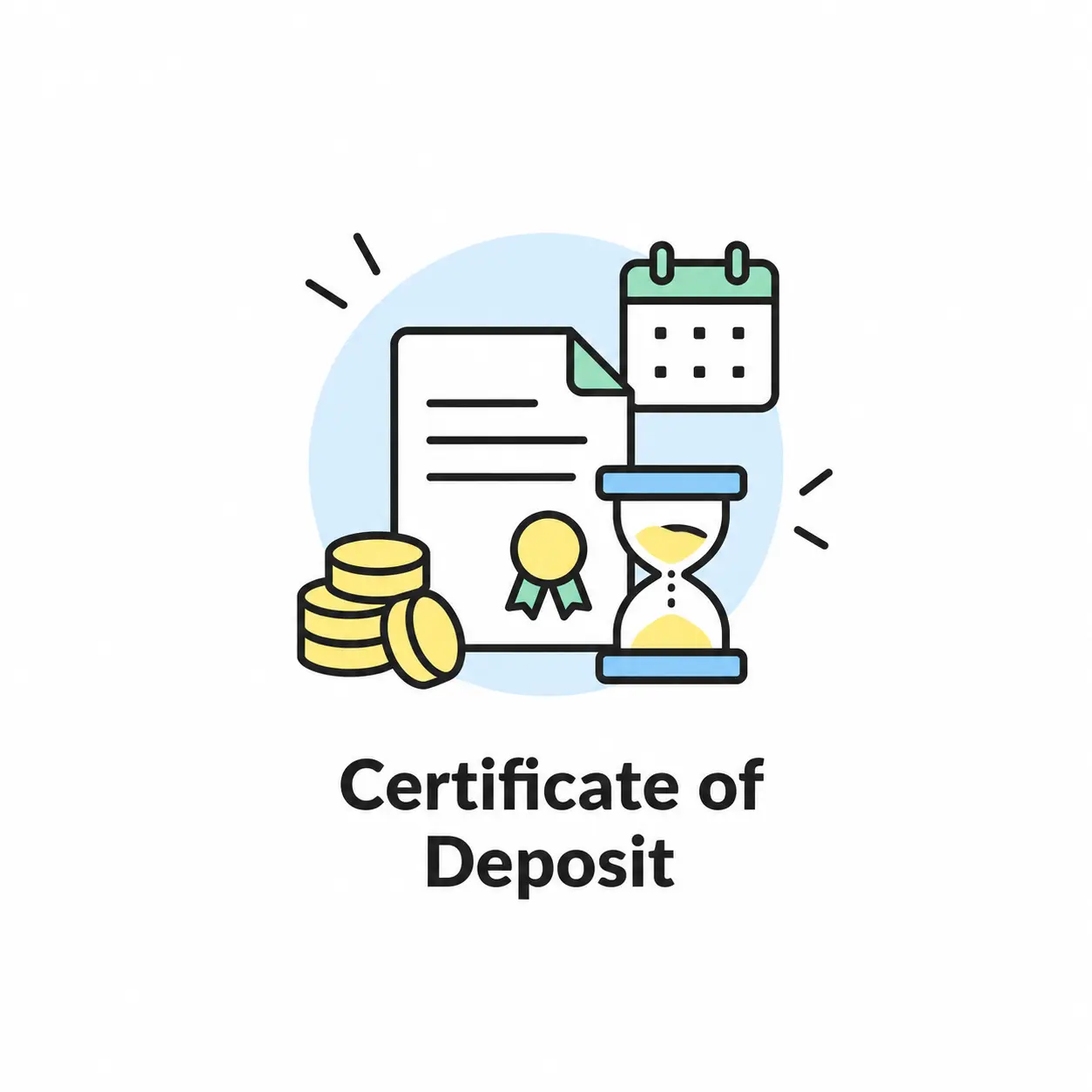
A certificate of deposit (CD) means a financial agreement between a bank and an investor. When you deposit money with the bank for a set period, the bank pays you back with interest. CDs offer predictable returns, even when market conditions worsen.
A CD owner can choose to withdraw interest monthly or annually, or wait until the certificate matures. Certificates of deposit can give you a safe harbor for investing if you want to shield your funds from stock market swings.
Plus, the FDIC (for banks) or the NCUA (for credit unions) protects your money up to $250,000 per depositor, as long as the bank offering the CD carries that insurance.
Reasons to Consider a CD
CDs stay among the safest instruments for keeping your money secure through market swings and rate changes. Here are some reasons to consider a CD:
- Certificates of deposit offer maximum security for your deposits
- CDs offer guaranteed income
- CDs require your money to stay deposited for a specific period of time
- With CDs, you avoid the temptation to dip into your savings
CD: The Fundamentals
Certificates of deposit (CDs) stay pretty simple to understand. To decide whether to buy a CD, you just need to know the initial deposit amount (the principal), the term of the contract (how long the money stays with the bank), and the interest rate.
Think of a CD as a savings plan that locks your money away, and once the time comes, you collect your proceeds.
How Does a CD Work?
To better understand how CDs work, and how certificate of deposit explained breaks down in practice, let’s look at this in more detail:
- Principal – the amount of the initial deposit. With CDs, this amount can vary a lot. You can invest as little as $500 or as much as you want.
- Term (or maturity term) – how long the CD lasts. This can range from several months to years. For example, you can choose a 12-month, 36-month, or 60-month CD, depending on your plans. This is probably the most important choice when buying a CD, since it decides the interest rate.
- Maturity date – the date the CD matures. This means you can withdraw your initial deposit plus interest. Remember this date, since it marks the end of the contract.
- Early withdrawal penalties – sanctions the bank imposes if you pull your money out before the maturity date. Banks design these penalties to discourage investors from breaking the contract. Usually, the penalty for early withdrawal from a CD equals several months’ worth of interest.
Example
Let’s walk through an example to better understand how CDs work. Suppose Sarah wants to renovate her kitchen. She expects the tile she wants will cost about $10k, and she’s saving for her dream kitchen over two years. But she knows she’ll blow the cash on random stuff if it just sits around.
So she grabs a 2-year CD at 4.5% APY. Now her money works for her, earning almost $1k. This way, Sarah gets to afford the tile with confidence, knowing her funds stay protected and that she’s fully prepared for the costs involved.
Under What Circumstances Is a CD Preferable to a Regular Savings Account?
- If you think rates are going to drop
- If you need help avoiding overspending
- Lastly, if you feel confident you won’t need the money for at least 1 to 5 years
How to Open a CD?
Most people complete CD openings online these days. There’s no need to visit the bank in person: fintech apps offer a wide range of services, from finding the best CDs to opening accounts. In most cases, though, it’s enough to:
Find the best CD rates: Online banks often offer higher rates thanks to lower overhead.
Determine the length of the contract (term): In other words, decide how long you want your money tied up with the bank so it can earn extra income for you. Terms of 12, 36, and 60 months remain the most popular options.
Complete the online registration form and provide personal information: You’ll need to give information like your date of birth, address, Social Security number, and other personal details to verify your identity.
Deposit funds: Lastly, once your account opens, transfer the desired amount from your bank account.
All you need to do is evaluate, analyze, and compare, then pick the best CD for your needs and budget.
The Pros and Cons of Longer-Term CDs
Pros
- You lock in your interest rate, and it cannot fall
- Compounded interest gives you extra income. Take a look at how a multi-year CD works with compound interest. For example, a five-year CD gives you more time to build up interest
- You gain the ability to earn guaranteed income with minimal risk. This matters especially for people with limited income, such as retirees
Cons
The main disadvantage of longer-term CDs comes down to so-called reinvestment risk. In other words, if interest rates rise, money sitting in a CD earns less income than it could elsewhere.
To manage this risk, many investors build what’s called a CD ladder, spreading deposits across multiple CDs with different maturity dates.
This approach lets you reinvest some of your money at higher rates as soon as CDs with longer terms mature.
To get the most out of your online banking, save money, and pay the least in fees, the Finance Nest Blog teaches newcomers how to use features like round-up apps and automatic transfers to save money without even trying.
How to Get the Highest Yield on a CD?
Here are the key steps to follow:
- Pay attention to news about interest rates. If you hear rumors of a nationwide rate decrease, try to lock up as large a sum as possible in a long-term CD, since longer terms usually carry higher rates
- Look for CDs with no-penalty clauses
- Lastly, consider buying brokered CDs
Key Takeaways
- A certificate of deposit locks your money away for a set term in exchange for a guaranteed interest rate, making it one of the safest ways to grow savings
- Certificate of deposit explained simply: you deposit a fixed sum, agree to a term, and collect your principal plus interest once the CD matures
- CD interest rates depend heavily on term length, with longer terms usually paying more, though a CD ladder helps manage the risk of rates rising later
- Early withdrawal penalties usually cost several months of interest, so only lock up money you won’t need before maturity
- FDIC or NCUA coverage protects CD deposits up to $250,000 per depositor, adding a real layer of safety
Final Words
A Certificate of Deposit (CD) might not seem particularly exciting: it’s fairly boring and does little to diversify your risk, but it does the job reliably.
CDs also bring real advantages, including security and predictable returns. So if you want to keep your money safe while still earning higher yields than a regular savings account, CDs can be a great tool for doing exactly that.
To maximize your profit, compare rates across different banks, since your primary institution likely won’t offer the best deal in the market. Lastly, use online tools to find the best offers and take advantage of this easy, secure way to grow your money.
FAQs
- What is a CD?A CD is a savings plan during which you cannot withdraw money, and the bank gives you higher interest as a reward for such restrictions.
- Can I lose money on a CD?You will not lose money on a CD if your deposits are within the FDIC or NCUA insurance limits and you do not prematurely withdraw funds. By prematurely withdrawing funds, you may forfeit some of the interest, but your initial deposit should be returned to you intact.
- How do banks choose the rates for CDs?Rates depend on several factors, including the federal funds rate, inflation, and competition between banks.
- Are CDs a better investment than stocks?Stocks are more volatile but can provide higher returns over time; CDs have lower risks and thus lower potential returns.