
Getting a loan might be similar to negotiating a challenging financial maze. However, mastering this process is necessary to accomplish significant life milestones.
Knowing how to increase loan approval chances can change your financial trajectory. If you want to buy a house, grow your business, or pay off high-interest debt.
Your long-term financial security is directly impacted by your capacity to obtain financing, which also determines your access to favourable interest rates. Also, opens doors to potential future wealth-building possibilities.
As a result, this article’s main goal is to give you practical, scientifically supported techniques. Plus, I will guide you through professional frameworks that will maximise your financial profile.
By using our guide, you will surely improve loan approval chances.
How to Increase the Probability of a Loan Approval
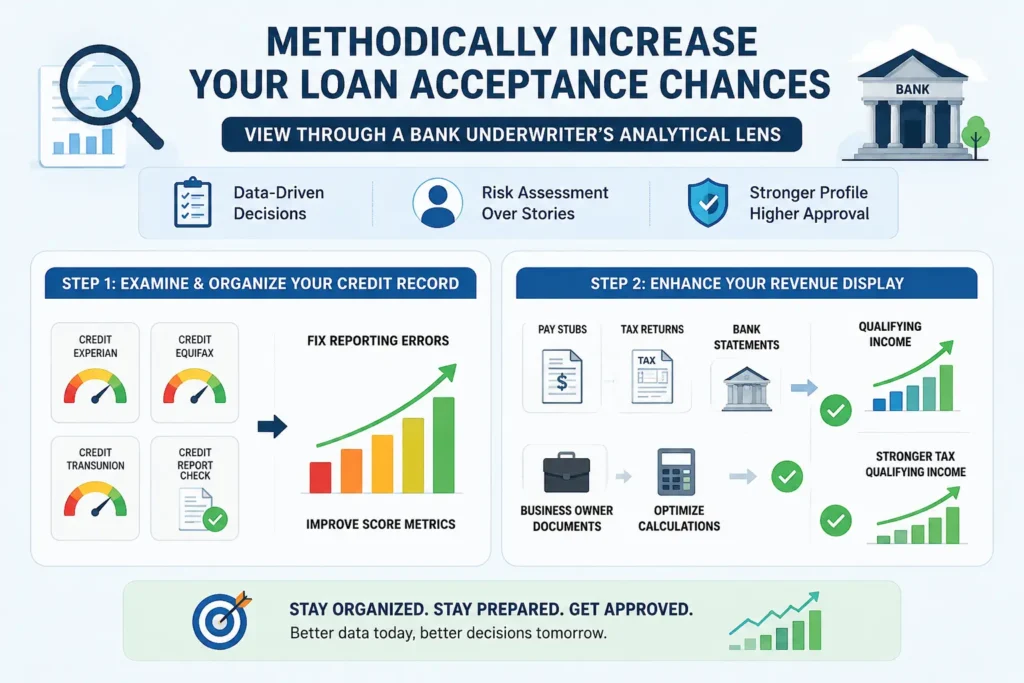
You must examine your financial picture through a bank underwriter’s analytical lens in order to methodically increase your chances of loan acceptance.
Whereas applications are assessed by lenders as data points that indicate risk rather than as narratives.
Examine and Organise Your Credit Record
Firstly, you have to examine your credit reports from Equifax, Experian, and TransUnion prior to applying.
Then look for bogus accounts that artificially lower your rating, out-of-date collections, or reporting problems.
Your credit score metrics can be immediately improved, and your loan decision can be changed from refusal to approval by fixing a single reporting error.
Enhance Your Revenue Display
Now, stable, readily provable revenue streams are preferred by lenders. If you work for a salary, get W-2 forms and consecutive pay stubs.
Because large deductions may unintentionally reduce your qualified income, freelancers and business owners should make sure their tax filings appropriately reflect their net revenues.
Factors lenders look at for loan approval
To assess your creditworthiness, financial firms use standardised indicators. By being aware of these elements, you can modify your financial practices prior to submitting an application. And you will improve loan approval chances.
The Credit’s Five Cs
- Lenders use the Five Cs, a classic financial framework, to assess applications:
- Character: Your payment history is the main indicator of your ability to repay debt.
- Capacity: Your ability to pay off the additional debt given your income and current commitments.
- Capital: The sum of money that you have saved or invested on your own.
- Collateral: Valuable assets you pledge to protect the loan and reduce the risk to the lender.
- Conditions: These include the money’s planned use, interest rate environments, and external economic conditions.
Payment History and Credit Utilisation
Approximately 35% of your credit score is determined by your history of timely payments.
Another thirty percent comes from your credit utilisation ratio, which measures how much revolving credit you utilise in relation to your entire credit limit.
Strong self-discipline is revealed by keeping your utilisation below 30%.
What Does a Good Debt-to-Income Ratio Mean for Loans?
One important mathematical formula utilised in loan acceptance evaluations is your Debt-to-Income (DTI) ratio. This measure contrasts your gross monthly income before taxes with your regular monthly debt payments.
How to Determine Your DTI
Your back-end DTI may be calculated using this simple formula:
$$\text{DTI Ratio} = \left( \frac{\text{Total Monthly Debt Payments}}{\text{Gross Monthly Income}} \right) \times 100$$
For instance, if your gross monthly income is $7,000 and your auto loan, credit card minimums, and potential mortgage add up to $2,500 per month, your DTI ratio is roughly 35.7%.
The DTI Target Thresholds
Based on this percentage, lenders classify borrowers into risk tiers:
A DTI ratio of less than 36% (Excellent)
This is regarded as healthy. It shows that you have a stable debt-to-income ratio, which makes you a very appealing candidate.
37% to 43% (Moderate Risk)
You might be approved by lenders, but they might demand more stringent asset paperwork or higher lending rates.
High Risk (over 43%)
This is a limiting warning sign. Applications in this range will typically be rejected by traditional lenders unless there are compelling reasons to do so.
Impact of Hard Credit Inquiries on Loan Approval
The lender conducts a rigorous inquiry into your credit file each time you formally submit an application for borrowing. To safeguard your position, you must comprehend how these checks operate.
Soft vs. Hard Questions
When you verify your own score or are pre-screened for an offer from a company, this is known as a soft inquiry. Your credit file is unaffected by soft enquiries. A hard inquiry, on the other hand, is when a financial institution obtains your credit report in order to decide whether to provide you with a smart loan.
The Risk of Switching Apps
An alert may sound if five distinct loan applications are submitted to five different lenders in one week. A sudden wave of difficult questions is seen by lenders as an indication of financial difficulties, which might reduce your chances of getting approved for a loan.
However, if conducted within a 14- to 45-day timeframe, contemporary credit models do combine related enquiries, such as searching for a mortgage or vehicle loan, into a single inquiry event.
To surely obtain a loan, Finance Nest Blog offers advice on how to pay off high-interest debt, loan guidance, the advantages, and loan repayment strategies.
The Best Debt Repayment Strategies for Loan Approval
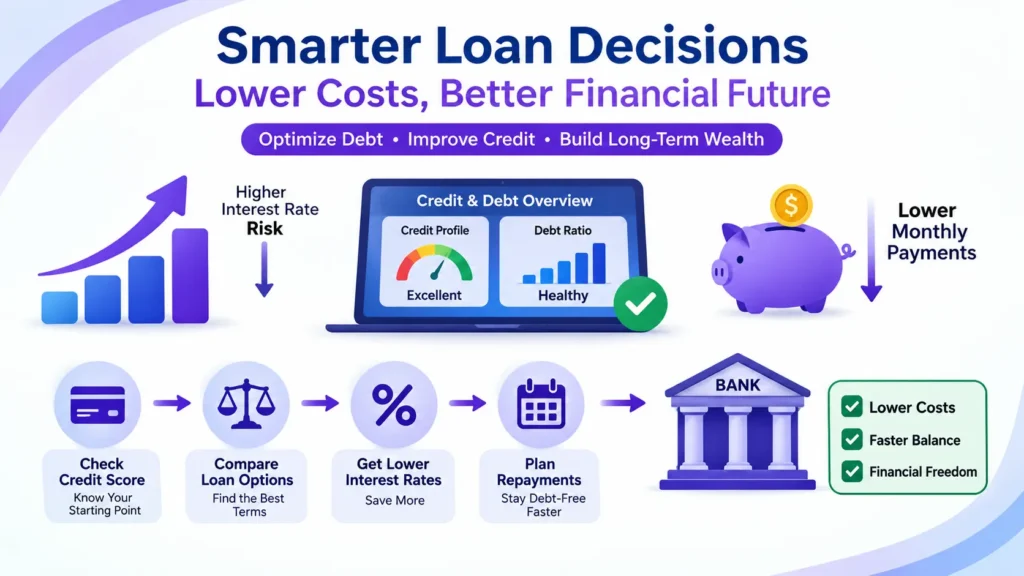
The quickest strategy to raise your credit score and maximise your DTI ratio before asking for financing is to aggressively reduce your existing debt. Two methodical approaches to debt management are particularly noteworthy:
The Method of Debt Avalanche
This method focuses on your loans in descending interest rate order. Every extra dollar is directed toward the card or loan with the highest interest rate while you make the minimum payments on all of your accounts. This reduces the overall amount of interest you pay over time mathematically.
The Snowball Method of Debt
By addressing your obligations in order of smallest to largest balance, this approach focuses on human psychology. You start by eliminating the smaller accounts, resulting in quick emotional wins that give you momentum to stay on course.
Top Credit Repair Companies for Loan Requests
Hiring a trustworthy credit repair firm might help improve your application profile if your credit report has significant faults or past mistakes that you find difficult to fix on your own.
Top-Rated Organisations
- Credit Saint: With transparent multi-tiered solutions and an easily accessible 90-day money-back guarantee, this company is consistently rated as an industry leader for thorough dispute resolution.
- Lexington Law: A well-known choice that uses paralegals and consumer protection lawyers to contest complicated bad ratings on your report.
- The Credit Pros: Well-known for resolving identity reporting difficulties by combining computerised credit monitoring with human assistance.
Steer clear of scams
Make sure that the business complies with the Credit Repair Organisations Act (CROA) at all times. Reputable companies would never claim to delete entirely valid unfavourable information from your report or demand high upfront costs before beginning repair.
How to Apply for Approved Personal Loans
Because they avoid the first uncertainty of borrowing, pre-approved personal loans provide a dependable route to secured funding.
The Pre-Approval Process
A lender does a soft credit check to assess your financial history before making a pre-approval offer. This saves you time because they have already confirmed that your credit history satisfies their fundamental underwriting standards.
Making the Most of Current Banking Connections
The best place to locate these deals is frequently your main savings or checking account. They can extend pre-approved alternatives with fewer processing obstacles, as they can examine your direct deposit history and real-time cash flow.
Verify Your Eligibility for a Loan Online
Before speaking with a loan officer, you can use the current financial market to confirm your status from the convenience of your home.
Detailed Online Verification
- Go to a reliable website for a multi-lender marketplace.
- Enter your housing expenses, employment status, and gross monthly income.
- To find out your baseline borrowing capacity, agree to a light credit draw.
- Examine predicted origin fees, interest rates, and payback schedules.
Identifying Missing Red Flags
You can get a sneak peek at any possible problems by doing an online check. You are aware that you must take time to reduce balances and raise credit score metrics before moving forward if an online platform says you are only qualified for high-interest loans.
Hire a loan broker for bad credit
Working individually with traditional banks may result in repeated denials if your credit profile is damaged or complex. Hiring a specialist loan broker might be a useful option in these circumstances.
Availability of Specialised Wholesale Lenders
Retail bank branches are subject to stringent regulations. On the other hand, a specialised bad credit loan broker has access to wholesale funders, private lending networks, and alternative financial institutions that consider factors other than typical credit ratings when approving applications.
How to Organise Your Application Package
A skilled broker is well-versed in how to present your application to emphasise compensating qualities.
A broker can craft your story to win over alternative underwriting teams if your credit and grade scores are poor, but you have a sizable cash down payment or a reliable source of income.
Winding it Up
As a result, deliberate financial care and precise long-term planning are necessary to obtain a competitive loan. You can improve your chances of getting a loan by optimising your debt-to-income ratio, carefully managing credit enquiries, and resolving report issues early.
Take proactive management of your accounts now, rather than waiting until you need funds to review your financial records. Your greatest weapon for navigating and improve loan approval chances.
Furthermore, you have to obtain better interest rates and creating a solid foundation for your future financial chances is consistent with financial management.
FAQs
- How long does it take to raise my credit score so I can apply for a loan?For your credit rating to really improve, you usually need to maintain consistent financial behaviour for three to six months. While restoring a history of on-time payments necessitates consistent attentiveness across multiple billing cycles, using credit repair services to correct inaccuracies can result in quicker improvements.
- If my debt-to-income ratio is more than 45%, would my loan be approved?Some alternative lending alternatives or government-backed programs may permit greater ratios if you have strong offsetting features, such as significant cash reserves or a high credit score, even though regular conforming loans typically cap DTIs at 43%.
- Does my credit report suffer when I check my eligibility online?No, provided that a soft credit check tool is used by the platform. Examining your initial pre-approved offers or verifying your baseline eligibility via a soft pull has no effect on your score and leaves no trace on your public record.
- If my credit is poor, is it worth paying a loan broker?Indeed. By connecting you directly with subprime or asset-based lenders who suit your particular circumstances, a broker can help you avoid a loop of harsh inquiry rejections if you have particular credit problems, making the broker's fee a wise investment.