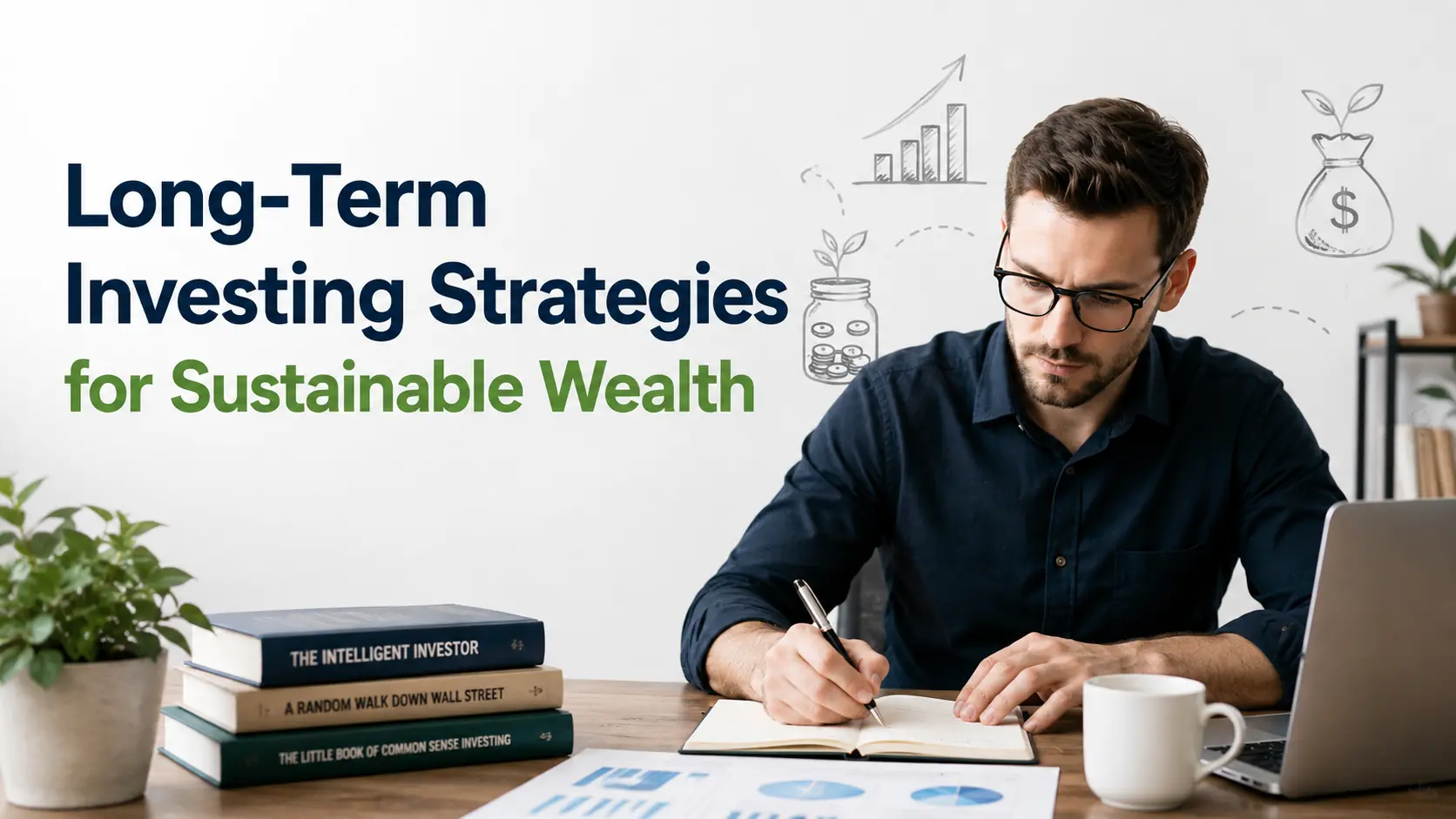
Think of planting a tiny acorn today, and watching it develop into a gigantic shade-giving oak in forty years.
This gradual, methodical approach is the nature of long term investing. Where capital is methodically cultivated to survive unpredictable market cycles.
In today’s volatile global economy, building lasting wealth is no longer a mere luxury for the average household. But a vital survival essential.
This all-in-one training package is meant to give you actionable long term investing strategy ideas to build generational wealth.
So, if you grasp how the mechanics of the standard market work and use automated digital instruments. Then select highly optimized tax-advantaged wealth accounts.
Hence, you can safely ensure your own financial independence starting from this very day of your life.
Lets delve more in the next section.
What Does dollar Cost Averaging Mean in investing?
What is Dollar Cost Averaging (DCA)
Dollar cost averaging is a systematic wealth-building investment approach in which an individual invests a preset dollar amount into a particular asset.
Moreover, it is also a diversified index fund on a regular and recurrent schedule. Regardless of whether or not the market prices are going up or down.
Core Mechanics
- Regular Contributions: You contribute the same cash amount on a regular basis (eg monthly or bi-weekly).
- Price Flexibility: If the price goes down, your fixed amount will be able to buy more shares; if the price goes up, it will buy fewer shares.
- Price averaging: This methodical process reduces your average cost per share over time and builds wealth gradually.
Behaviors Benefit
Eliminates Market Timing:
It reduces the stress and temptation of trying to predict the turbulent peaks and dips of the market.
Removes Emotional Bias:
Automation of your contributions means you do not panic sell during abrupt downturns. And you can stay on course with your long-term plan.
A Monthly Practical Example
Now say you are investing a fixed sum of $400$ each month in a diversified index fund:
- Month 1: Share price $40$ $\rightarrow$ Your $400$ gets you $10$ shares.
- 2n Month: Market correction sends share price down to $20$ $\rightarrow$ Your $400$ automatically buys $20$ shares.
- Month 3: Price partially rebounds to $25$ $\rightarrow$ Your $400$ buys $16$ shares.
The Mathematical Comparison:
- Total Capital Contributed: $1200.00$
- Total Shares Built Up: $46$
- Your average cost basis is approximately $26.09 per share.
- Average Market Price: $28.33$ throughout the same three-month period.
As a result, this approach translates market fluctuations into a structural advantage. And allows you to consistently compound without the necessity of daily portfolio monitoring.
Best long term Investment Strategies for Beginners
Getting started in asset accumulation can be intimidating for long term investing. But the secret to continuous execution is to keep your strategy simple.
So, you do not need to actively trade, analyze technical charts, or pick individual winning stocks to create wealth successfully.
Instead, beginners should concentrate on three basic pillars: asset allocation (splitting your portfolio between equities and fixed-income bonds).
After that, diversification (sharing your risk over hundreds of assets), and automation (taking human emotion out of the equation).
Actionable Investing Tips for New Investors
Below are the actionable investing tips for beginners.
- Create Your Defensive Shield First: Make sure you have a fully funded Emergency Fund sitting in a liquid. Then, a high-yield savings account before you put investments into unpredictable markets. Further, this buffer protects your compounding engine from structural disturbance by preventing you from having to liquidate your market investments at a loss to pay for unforeseen auto repairs or medical expenditures.
- Automate Your Contributions: Now, set up automated monthly sweeps to move money immediately from your paycheck to your brokerage account before you may spend it. By doing so, this creates a habit that takes zero willpower every month.
- Index Funds: Diversify. Diversification is your best friend. Instead of attempting to choose individual winners, put your money into low-cost mutual funds or exchange-traded funds that own hundreds of worldwide stocks at once.
- Focus on the Horizon: Using these key long term investing strategies, a beginner can simply reduce emotional decision-making, ride out temporary market declines. Hence, you will reap the benefits of consistent, passive growth over several decades.
How to Calculate Compound Interest using Examples
Compound interest is known as the eighth wonder of the world because of its capability to multiply wealth exponentially.
Compound interest is different from simple interest in that it pays you interest on the original principal as well as on the interest you have earned to date.
But over time, this compounding cycle snowballs, enabling your money to do the heavy lifting for you.
This standard equation can be used to express the mathematical future worth of a compounding portfolio:
$$A = P \left(1 + \frac{r}{n}\right)^{nt}$$
Where:
- $A$ is the future worth of your investment.
- $P$ is your starting main deposit.
- $r$ is the annualized projected interest rate or average market return
- $n$ is the number of times the interest is compounded every year
- $t$ is the total investment horizon in years
To see this mathematical wizardry in the real world, let us examine two different investor profiles over a multi-decade timeframe, assuming a cautious 8% annual return compounded monthly ($n = 12$):
Best online brokerages for long-term investing
Choosing the right financial institution to hold your investment portfolio is a key decision that will directly affect your long-term returns.
Today, brokerage platforms have changed the investing scene – eliminating traditional trading commissions. Therefore, they offer fractional share access and provide powerful digital tools to streamline portfolio management.
When picking a platform, seek out institutions with minimal operating fees, a broad selection of cheap index funds, and excellent security measures. Three highly rated online brokerages are the leaders in the industry:
Vanguard:
Known for its client-owned corporate structure, which allows gains to be plowed back directly to reduce fund fees. This is the place to go if you are a passive long-term index fund investor who wants to keep costs as low as possible.
Fidelity:
A well-regarded private company with an easy-to-use digital trading platform and no minimum account requirements. Also, it is a first-of-its-kind family of zero-expense-ratio mutual funds (Fidelity Zero Funds).
Charles Schwab
Complete customer service and massive educational materials. And a robust, customize auto-portfolio (Schwab Intelligent Portfolios) that is great for hands-off investors.
The base of successful long-term investing is to select a platform that is in line with your objectives. These brokerages reduce administrative friction and keep expenses to a minimum, so more of your wealth is working for you in the market.
Top performing dividend ETFs to buy this year
If you are an investor seeking a stable source of passive income and capital growth, dividend-oriented Exchange-Traded Funds (ETFs) are a great addition to a portfolio.
Rather than having to investigate and buy dozens of individual dividend-paying organizations, a specialist ETF packages these top-tier companies into a single, highly liquid asset.
- SCHD (Schwab U.S. Dividend Equity ETF): SCHD is regard as the gold standard for dividend growth, screening for financially strong, high-quality companies with sustainable payout histories. Its super low fee structure and sustained dividend growth rate make it a top choice.
- VYM (Vanguard High Dividend Yield ETF): This huge, low-cost portfolio offers exposure to almost 550 stocks with above-average dividend yields, focusing on cash flow now versus dividend growth.
- FDVV (Fidelity High Dividend ETF): FDVV looks for large-cap stocks that provide high dividend yields, but it also sticks with high-growth industries such as technology, which creates a good blend of capital appreciation and current income.
Open a Roth IRA account online
The Roth Individual Retirement Account (IRA) is one of the most powerful tax-advantaged vehicles available to ordinary investors.
Unlike typical retirement plans, which allow for tax-deductible contributions. But taxed withdrawals, a Roth IRA is funded using after-tax dollars.
This implies that your underlying investments grow totally tax-free, and all qualifying withdrawals you make in retirement are 100% tax-free.
It takes less than 10 minutes to open a Roth IRA online by following the digital onboarding process offered at any major online brokerage.
In 2026, qualified people can contribute up to $7,000 a year (or $8,000 if you’re 50 or older) as long as your modified adjusted gross income is below the federal limits.
You can arrange automatic monthly deposits of around $583 into your Roth IRA and effortlessly maximize your tax-free development potential while building a substantial financial safety net for your retirement years.
Buy low-cost S&P 500 index Funds
If you do not want to deal with the headache of choosing your own stocks, the best way to generate wealth is to buy a low-cost index fund that tracks the S&P 500.
It tracks five hundred of the largest, most successful publicly traded companies in the United States, in IT, healthcare, financials, and consumer services.
For instance, if you invest in a single share of an S&P 500 index fund (such as VOO by Vanguard or FXAIX by Fidelity), you immediately diversify your investment across titans such as Apple, Microsoft, Amazon, and Berkshire Hathaway.
The S&P 500 has historically returned about 10% every year, on average, over the long haul. This continuous performance easily surpasses the overwhelming majority of actively managed mutual funds, and it shows that a passive, low-cost method is the best guarantee to secure your future financial freedom.
Final Thought
Hence, building sustained wealth does not require long term investing, intricate trading formulae, or regular market monitoring.
Set up to contribute automatically, use low-cost diversified index funds, and stick with it through the cycles, and you are allowing passive compounding to create your financial security.
So, you must begin to put into action your financial strategy for your patient today. And believe in the historical growth rate of the global markets, and let time uncover your ultimate financial freedom.
FAQs
- What is the best age to start patient investing?You can start at any age, but the sooner you start the more time compounding has to work on your capital. Saving tiny amounts in your twenties will add up to far more than saving greater amounts later in life.
- What happens to passive investments in a bear market?Short term corrections are rather usual and, historically, transitory. For the patient investor, downturns are opportunities to use automatic dollar cost averaging to acquire top-quality index funds and stocks at a discount.
- Can I put my main Emergency Fund in the stock market?No. Your major Emergency Fund needs to be very liquid and safe, preferably in a high-yield savings account or short-term certificate of deposit. Investing them in volatile equities means you risk having to liquidate these savings amid a sudden personal crisis at a loss.
- What is a safe withdrawal rate for retirement?Financial advisers typically mention the "4% Rule" as a reliable rule of thumb. This technique implies that removing 4% of the total value of your portfolio in the first year of retirement, and increasing that dollar amount each year for inflation, provides your portfolio a very good possibility of surviving thirty years or longer.