Building a strong financial future starts with one basic choice. Where should hard-earned cash actually go? So the choice between stocks and bonds is the first real question any new investor faces.
One path offers a shot at big growth. Instead, the other offers steady returns and some shelter during rough markets. So understanding stocks vs bonds matters a lot here. It helps decide which mix fits a given time horizon best.
This guide covers both sides in plain terms. The goal is simple. Help you choose with real confidence.
Stocks vs Bonds: The Main Differences at a Glance
Stocks mean owning a small piece of a company. Instead, bonds mean lending money to one.
Who Issues Them
Only companies issue stocks. But bonds get issued by companies too. In fact, they also come from the federal government, and from state and city governments.
How They Pay You
Stocks can grow in price, and some also pay dividends. Instead, bonds pay fixed interest on a set schedule. Then they repay the original loan amount at the end.
How Much You Can Gain
Stock gains have no real cap. For example, a company’s success can send its share price way up. Bonds work differently though. The income stream stays fixed from the start.
What You Risk Losing
If a company fails, bondholders get paid before stockholders do. So that single fact makes stocks riskier overall. Stock prices also swing with the economy, the news, and how a company performs.
Stocks vs Bonds: Risk, Swings, Cash Access, and Income
How Do Stocks Work?
A stock is one small unit of ownership in a public company. When the company does well and grows in value, the stock price climbs. As a result, shareholders gain along with it.
Stocks mainly pay off two ways:
- Price growth – selling shares later for more than they cost
- Dividends – small regular payouts some companies share with owners
What Are Bonds?
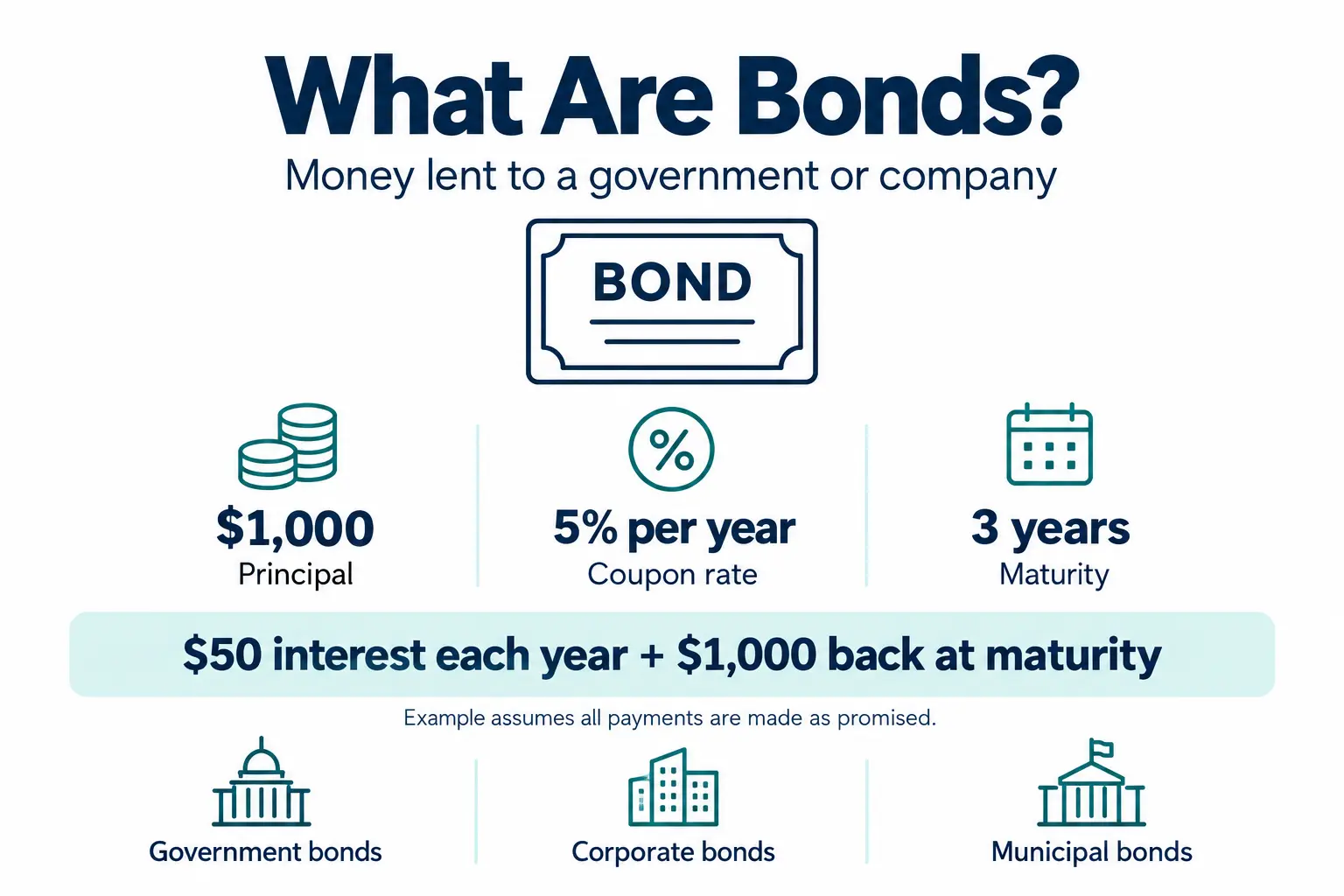
A bond is a loan given to an entity. In return, the lender gets regular interest payments, called coupons. So the full loan amount, called the principal, comes back at the end.
The Basic Parts of a Bond
- Principal – the size of the loan, equal to the bond’s face value
- Coupon rate – the yearly interest rate paid, shown as a percent of face value
- Maturity date – the day the loan gets paid back in full
Types of Bonds
- Government bonds – issued by national governments and central banks, very low default risk
- Corporate bonds – issued by companies, some default risk, but higher payouts
- Municipal bonds – issued by cities or states, fairly low risk, sometimes tax-friendly too
Stocks vs Bonds: Risk vs Return
Every investment carries some kind of risk-return trade-off. So stocks and bonds are no different. Knowing how each one behaves helps in building a solid portfolio.
Investment Risk in Stocks
Stock prices move a lot, and often fast. In fact, prices react to economic shifts, investor mood, and how much risk people feel comfortable taking on right now.
What Kind of Returns Stocks Give
Stocks can grow through price gains and dividends together. On average, stocks return around 8% a year over the long run. Some years land well above that. But some years go negative.
Managing Risk in Bonds
Bonds tend to be safer than stocks. But they still carry real risk.
- Interest rate risk – bond prices and interest rates move in opposite directions. So when rates rise, bond prices fall.
- Inflation risk – inflation quietly eats into money’s value over time. Since bond coupons stay fixed, that fixed income buys less as prices rise elsewhere.
So to dig deeper into stocks, bonds, ETFs, and investing basics, the Finance Nest blog covers all of it in plain language for beginners.
Cause and Effect: How These Forces Actually Connect
A lot of confusion around stocks vs bonds for beginners comes from not seeing how one thing leads to another. So here’s the short version.
- Interest rates go up → bond prices go down. Because older bonds paying a lower rate become less attractive once new bonds offer more.
- A company grows profits → its stock price often rises. Since more earnings usually means more value placed on each share.
- Inflation rises → fixed bond income loses buying power. The coupon stays the same, but everything it buys costs more.
- A company struggles financially → bondholders get paid first, stockholders last. This is exactly why stocks carry more downside risk.
- The economy slows down → stocks usually feel it faster than bonds. Because stock prices react quickly to bad news, while bond payments stay contractually fixed.
So seeing these cause-and-effect links makes the whole stocks vs bonds decision feel a lot less abstract.
The Best Place to Buy Stocks and Bonds
Before picking a brokerage, decide one thing first. Active trading, or a hands-off robo-advisor?
Features Worth Looking For
- Zero-commission trades – no fee charged just to buy or sell
- Fractional shares – the option to buy a small slice of an expensive stock
- Bond access – the ability to buy both company and government bonds
Best Types of Brokerages for Beginners
New traders should look for ease of use, simple account setup, and clear fee structures.
- Full-service online brokers – strong research tools, no-commission trades, access to both stocks and bonds
- Fintech apps – simple, modern apps built for fast stock buying and robo-investing
- Robo-advisors – automated services that build a mixed stock-and-bond portfolio for you
Credit and Default Risk in Bonds
Default risk means the issuer might fail to make interest or principal payments as promised.
Buying Government Bonds Directly
Another option exists here too. So open an account directly with the issuer, skipping a broker entirely.
Comparing a Few Popular Platforms
Fidelity
Best for long-term investing and steady growth. Offers fractional shares from $1, zero-commission trades, no account minimum, and strong learning resources.
Robinhood
Best for fast setup and a simple mobile app. Offers quick bank transfers, commission-free stocks, ETFs, and options trading, no minimum balance, and an easy interface.
Webull
Best for beginners who want simple charts and tools. Offers extended trading hours, 0% commissions, practice trading with fake money, and full fractional share support.
How to Buy Government Bonds
- Open an account – sign up through a government platform like TreasuryDirect for U.S. bonds
- Pick a term – bills run 4 to 52 weeks, notes run 2 to 10 years, bonds run 20 to 30 years
- Fund the account – transfer money in and start buying
How to Start Buying Stocks
A first stock purchase really just takes a few clear steps.
Set a Goal
Know why the money is going in. Retirement? A future big purchase? Something else?
Pick a Simple Allocation
Index funds often beat picking individual stocks for beginners. So they track a whole market index at once.
Automate Monthly Contributions
Set up automatic transfers into a brokerage account. This builds a dollar-cost averaging habit without much extra thought.
Key Takeaways
- The core stocks vs bonds decision comes down to growth potential versus steady, fixed income
- Stocks vs bonds for beginners rarely means picking just one, most balanced portfolios hold both
- Investment risk works differently for each: stock prices swing with the market, while bonds carry interest rate and inflation risk instead
- A simple age-based rule, 100 or 110 minus your age, gives a rough starting point for how much to hold in stocks
- Understanding cause and effect, like rising rates pushing bond prices down, makes real investment risk far easier to manage
Conclusion
This guide set out to cover the real differences between stocks and bonds clearly. Stocks mean ownership, with price growth and dividends as the payoff. Instead, bonds mean lending, with steady, fixed income in return.
Choosing the right mix comes down to time horizon and comfort with risk. So a diversified portfolio, holding both stocks and bonds, tends to grow steadily while smoothing out the rough patches either asset class hits alone.
So keep learning as the market changes, and start applying this stocks vs bonds guide with a clearer, more confident plan.
FAQs
- What is the main difference in the debate of stocks vs bonds?Stocks represent ownership in a company and offer price growth, while bonds represent debt, offering fixed interest payments and principal repayment.
- Is stocks vs bonds for beginners a binary choice?No, most beginning investors hold both. Bonds add stability, while stocks add stronger growth potential.
- How do interest rates affect bond prices?Interest rates and bond prices move in opposite directions. So when rates rise, bond prices fall.
- How much of my portfolio should involve stocks versus bonds?It depends on age and risk comfort, but a common rule of thumb sets stock allocation at 100 or 110 minus your age.