
Did you know that if you had invested in a successful firm like Apple in 2001, you would have become a billionaire? Whereas investing in a failed company could have wiped out your funds overnight.
This high stakes reality is fueling a huge wave of interest from novice investors, torn between individual stocks and Exchange-Traded Funds (ETFs). Stocks bring exciting growth.
But ETFs are instant diversified safety. In this tutorial, we evaluate stocks vs ETFs side by side so you can make the appropriate choice to successfully achieve your long-term financial goals.
Understanding Stock
What is a Stock?
A stock is a division of ownership in a publicly traded firm and is sometimes called an equity share. When you buy a share of a business, you are buying a modest claim on that organization’s physical infrastructure, intellectual property and future net revenues.
Brief Explanation of How the Stock Market Works
Public corporations offer their shares on large public stock exchanges such as the New York Stock Exchange (NYSE) or the NASDAQ. These shares are subject to constant price change throughout the normal trading day under the pure laws of supply and demand.
When a firm announces great quarterly earnings or an innovative product line, more investors want to acquire the stock, sending its price higher.
Conversely, poor management decisions, fines for regulatory violations, or industry-wide downturns can lead to mass selling, which can quickly erode the market value of the stock.
Advantages of Investing in Stocks
- Potential for High Return: Individual stocks can increase without limit. Investments in an early-stage firm that matures into a leader in its sector can reward you with life-changing financial appreciation that much exceeds broad index benchmarks.
- Direct Ownership and voting rights: By directly owning common stock, you have genuine shareholder rights, including voting rights. This includes voting on important company matters, electing directors, and attending annual meetings in person.
- Opportunity to Invest in Certain Companies: When you buy stocks, you may build a hyper-customized portfolio that represents your particular views. If you are sure that a particular company is going to rule the renewable energy or artificial intelligence space, then you may put your money where your mouth is and invest directly in that company.
Cons of Stock Investments
- Higher Risk Than ETFs: When you purchase one stock, your money is dependent on the existence and performance of a single organization. If that company goes bankrupt or has an accounting crisis, your portfolio can suffer huge irreversible losses.
- Need for In-depth Research on Companies: Managing a portfolio of individual stocks is a lot of mental energy and homework. It means conducting regular audits of complex balance sheets, income statements, regulatory filings, and competitive market dynamics to avoid imprudent investments.
- Market Volatility and Risk of Loss: Equity securities are exposed to short-term news, macroeconomic changes, and analyst opinion. That kind of volatility can lead to steep, sudden drawdowns that might test an investor’s emotional control.
Understanding Exchange Traded Funds (ETFs)
What Are Exchange Traded Funds?
Definition: A group of stocks or other assets that are bundled together as a single investment.
An Exchange-Traded Fund (ETF) is a collective investment instrument that pools the funds of thousands of regular investors to acquire a big, diversified basket of underlying securities. Rather than buying a single stock, one share of an ETF might provide you with fractional exposure to hundreds or thousands of different corporate stocks, bonds, or commodities all at once.
How ETFs trade like stocks on the stock exchange.
But unlike typical mutual funds that calculate net asset value (NAV) and settle trades only once a day after the closing bell, ETFs are directly quoted on public stock exchanges.
They trade throughout the normal market session constantly, with live and real-time pricing, which means that you can buy or sell shares at any second during market hours.
Advantages of Investing in ETFs
- Diversification: Spreads risk over numerous assets: The major advantage of an ETF is rapid, structural diversification. An S&P 500 ETF spreads your cash over the 500 biggest businesses in the United States, which implies that a dip in a few companies is cushioned by the stability of the other enterprises.
- Lower expense ratio and fees than mutual funds: Most conventional ETFs are passively managed index funds that mirror an existing market benchmark. They don’t require expensive teams of active managers and hence have unbelievably low yearly operational fees, frequently less than 0.05%.
- Easy Trading and Possible Tax Benefits: Thanks to an unusual structural feature known as the “in-kind creation and redemption process,” ETFs often are not required to distribute capital gains to their shareholders. This makes them much more tax efficient than standard mutual funds when kept in taxable brokerage accounts.
Cons of Investing in ETFs
- May not provide the same returns as picking the right stocks: ETFs are designed to be broadly diversified and hence will generally give average market returns. Avoid catastrophic failure, but in exchange, you’ll never have the chance to get the enormous multi-bagger returns that come from picking an individual successful investment.
- Less Control Over Individual Investments: When you buy an ETF, you are stuck with the same index methodology of the fund. If you’re invested in a big tech ETF and don’t like or have a moral objection to one of the companies in it, you can’t filter that one company out or remove it from your holdings.
- Some costs May Apply, Such as Bid-Ask Spreads: Tracking costs are small, but trading highly illiquid or specialty sector ETFs may expose you to huge bid-ask spreads, which operate as a hidden transaction cost every time you purchase or enter a position.
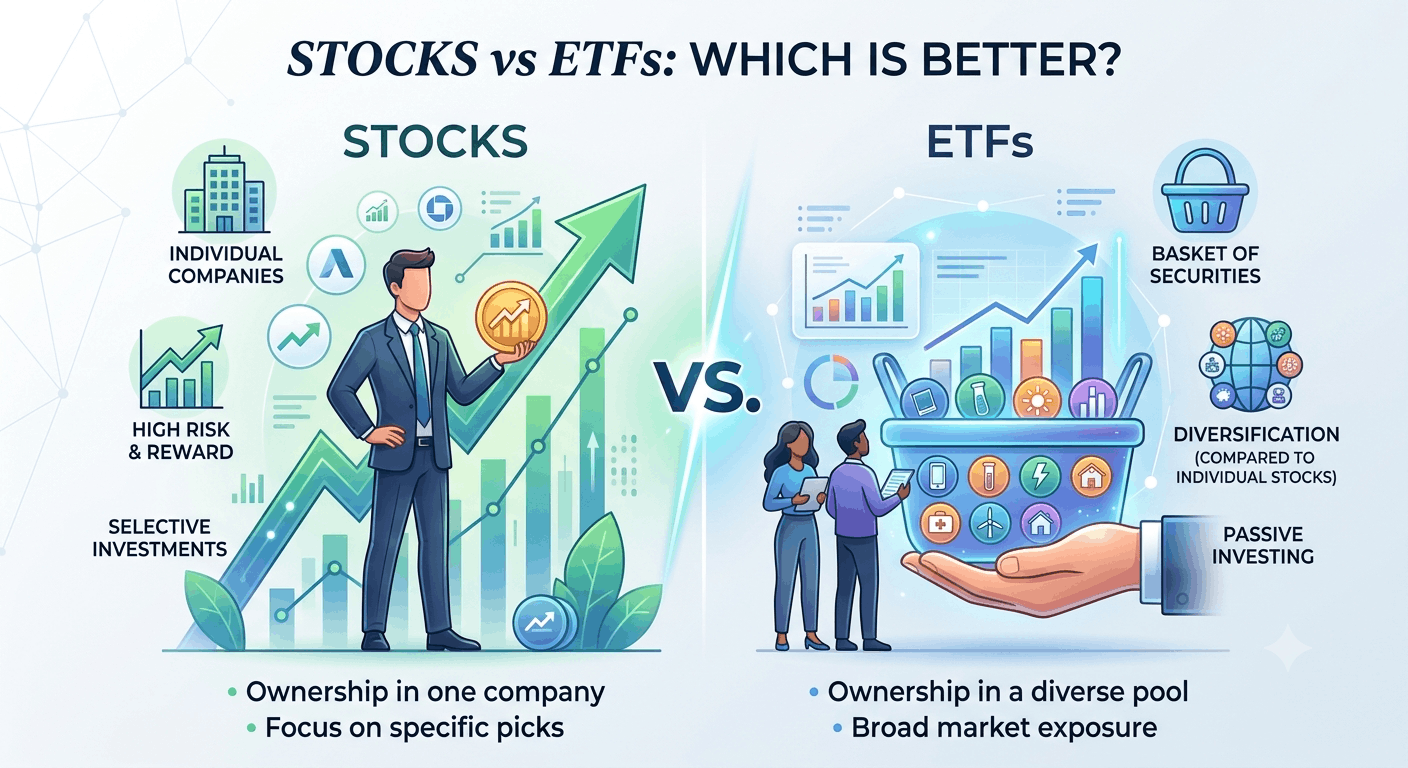
Stocks vs ETFs: Which is Better
When it comes to choosing between stocks vs ETFs, you need to consider how each vehicle fits into your broader financial goals. One choice is not necessarily better than the other; the utility of each relies on your financial structure.
[ Total Invested Capital ]
│ ┌──────────────────┬──────────────────┐ │ ▼ ▼ [ Single Stocks ] [ ETF with diversification ]
(High Risk / High Reward) (Market-Average Returns) │ │ Focused Assets Wide Asset Basket
Investment Objectives
Your choice of vehicle depends on your desired milestones. If your goal is to generate aggressive, market-beating alpha to compound a little amount of capital quickly, individual stocks provide the leverage needed. If you want safe, long-term preservation of wealth and gradual compounding for a retirement decades away, a broad-market index ETF is a safer base.
Risk Appetite
You must be able to bear paper losses emotionally and structurally. Single stocks are characterized by significant idiosyncratic risk, risk specific to a single firm. If your stomach flips when you see the holding drop 15% in one trading session, your risk tolerance guides you immediately to ETFs, where asset clustering smooths out unpredictable market fluctuations.
Time Involvement
Successful stock market investing takes an enormous investment of your own hours. Active stock pickers spend hours each week reading quarterly earnings transcripts, tracking industry disruptions and calculating value ratios. On the other hand, an ETF approach requires little continuing upkeep and can be a true “set-it-and-forget-it” routine.
Cost
Most current brokerages offer zero-commission trading for both vehicles, although their long-term cost profiles differ:
The Right Time to Buy Stocks
If you have some behavioral tendencies, then investing directly in individual corporate equities is a really good way to go:
- You really like examining companies: You view equity analysis as an intellectual problem to solve, not as a chore.
- You want concentrated ownership: You want to be heavily invested in specialist sectors, leading-edge businesses, or corporate management teams that you think Wall Street is grossly underappreciating.
- You have a long investment horizon: You have a high risk tolerance and a multi-decade timeline, so temporary market downturns won’t make you panic-sell your core positions.
When to pick ETFs
Diversified funds are generally the best choice if your lifestyle fulfills the following criteria:
- You like passive simplicity: You enjoy an automated financial routine with little direct oversight and less hands-on portfolio management.
- You want safety over outperformance: You want broad, diversified exposure to entire economic sectors with far less chance of individual firm bankruptcies.
- You are constructing your initial capital base: You are at the outset of your career and require a highly diversified, institutional-grade base without having to buy dozens of expensive individual stocks manually.
How to Purchase and Execute
You need a strategy for investing in the stock market to get your decisions out of the paper and into the actual market:
1. Open an Account:
Pick a high-rated, no-commission online brokerage platform (like Fidelity, Vanguard or Charles Schwab), and verify your digital identity.
2. Fund the Portfolio:
Link a standard checking account to a secure ACH routing for a constant stream of capital.
3. Research Your Asset Identifiers:
Find the exact unique ticker symbol for the asset you want to trade (Apple stock is AAPL, whereas Vanguard’s Total Stock Market ETF is VTI, for example).
Place the Order: Indicate how many shares you want to buy or sell. Pick a ” Market Order ” to trade at the current price, or a ” Limit Order ” to trade only at a certain price or better. Confirm the trade and submit it within normal market hours.
Winding it UP
When it comes to maximizing your wealth, it is all about where you are on the risk-time-interest continuum. The choice of stocks vs ETFs is not about picking the perfect asset; it’s about choosing the instrument that fits your financial goals.
Build a diversified portfolio, set up automatic monthly contributions, and allow the market to compound and grow your wealth.
FAQs
- Can I own individual stocks and ETFs in the same brokerage account?Certainly. A lot of people invest using the core-satellite approach. They put 80% in very diversified, very stable ETFs for a safe basis. Then they use the other 20% to be aggressive for growth by picking specific stocks.
- Do ETFs pay out dividends on a regular basis to shareholders?Yes, it is. The companies in the ETF pay cash dividends, and the fund manager collects those cash dividends and pays them out on a pro-rata basis to the ETF shareholders. This is normally done on a fixed quarterly schedule.
- What happens if one of the companies in an ETF goes bankrupt?Since the ETF owns hundreds of different equities, the bankruptcy of a single business has an exceedingly modest, practically imperceptible effect on the total value of the fund. The fund management simply takes out the firm that failed and puts it in at their next normal rebalancing time.
- Is there a minimum amount of money I have to put down to start buying stocks or ETFs?No. Most current internet brokerages have $0 account minimums. Plus, many platforms now provide fractional share trading, so you may start investing in high-end ETFs or expensive equities with just $1.